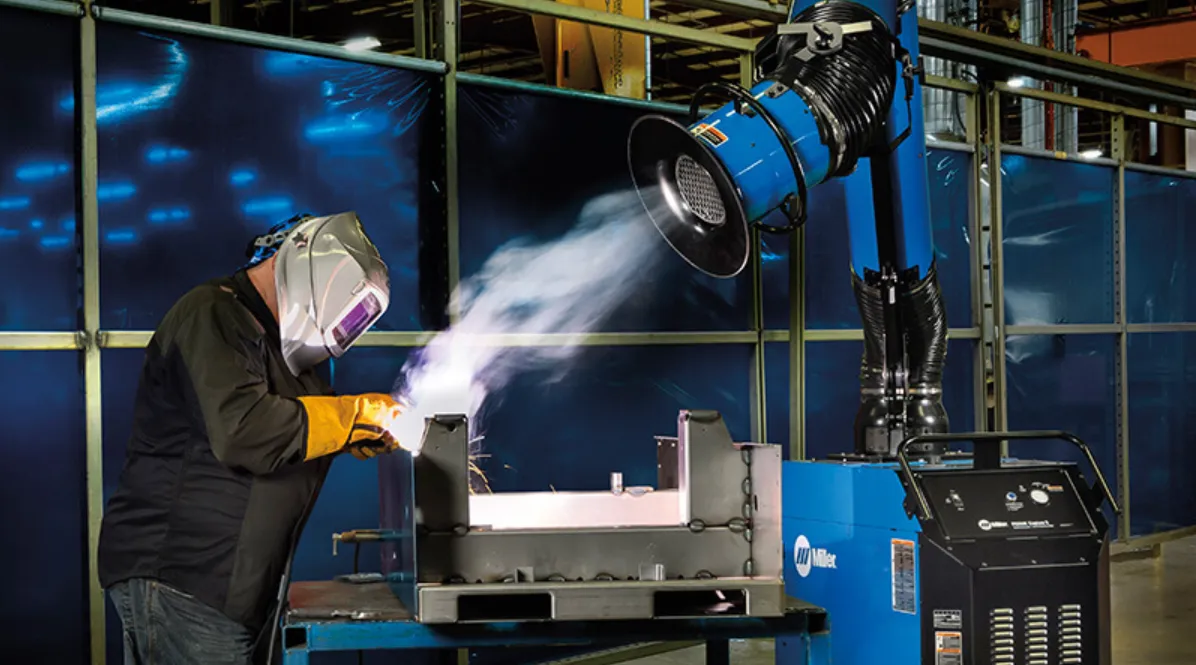
Welding shops face a familiar squeeze: limited floor space, rising air quality standards, and workers who deserve to breathe clean air at their benches. The old approach of rolling a cart-style extractor from station to station no longer cuts it. Instead, a growing number of fabrication facilities are installing extraction systems directly at the point of fume generation, transforming how shops manage workplace air quality and layout.
Key Takeaways
- Wall-mounted extraction systems eliminate the need for rolling equipment that consumes valuable shop floor space and mobility.
- Fixed extraction positioned at workstations captures fumes at the source, before they spread into the wider shop environment.
- Compliance with local air quality regulations and worker safety expectations increasingly favors permanent, dedicated extraction solutions.
- Modern wall-mounted systems balance industrial-grade performance with designs that fit tight workshop footprints.
Why It Matters
Workplace air quality has become a serious business consideration, not just a safety checkbox. Workers in welding shops spend eight hours a day breathing air contaminated by metal fumes, particulates, and gases produced during arc welding, stick welding, MIG, and TIG processes. Poor air quality leads to respiratory issues, lost productivity, and higher turnover. Regulatory bodies and insurance carriers are also scrutinizing ventilation systems more closely, making air quality infrastructure a legitimate cost of operations.
Shops that delay investing in proper fume extraction often discover that retrofitting is far more expensive than planning for it upfront. A wall mounted fume extractor installed during shop setup or renovation locks the system in place, reducing future disruptions and ensuring consistent air quality across all workstations. Beyond regulatory compliance, shops with clean air report better employee retention, fewer health-related absences, and a stronger safety culture that attracts skilled welders.
The Space and Efficiency Case for Wall-Mounted Systems
Every square foot of shop floor carries a cost. Renting, heating, and maintaining workspace is a significant overhead line item, especially in urban or industrial areas where real estate is expensive. Rolling equipment takes up permanent space even when idle and creates traffic congestion as operators move carts between stations. Wire trays, material storage, and work benches already compete for available floor real estate.
Wall-mounted extraction eliminates this friction. By anchoring the system to vertical space, shops preserve floor real estate for actual production. Operators no longer position their bodies around a rolling cart; instead, the extraction point hangs directly above or beside the welding station. This arrangement shortens the capture distance between fume source and filter, which improves extraction efficiency and reduces the volume of contaminated air that drifts into the wider shop.
Efficiency gains ripple outward. Cleaner air at the welding station means less contamination settling on other equipment, reducing maintenance time on mills, lathes, and tools. Welders can focus on their work instead of maneuvering around extraction carts, which translates to faster cycle times and fewer setup errors.
Compliance and Regulatory Pressure
Occupational exposure limits for welding fumes are set by federal and state agencies. OSHA’s permissible exposure limits (PELs) for metal fumes vary by substance, but the general expectation is that employers control airborne contaminants through engineering controls (like local exhaust ventilation) before relying on respirators as a backup. Many states have adopted stricter standards than federal minimums, and some municipalities have begun enforcing air quality rules that apply to fabrication shops located in mixed-use areas.
Wall-mounted systems satisfy the hierarchy of controls by addressing fumes at the source. Insurance carriers and safety auditors view fixed extraction as evidence of genuine commitment to compliance, which can influence premium rates and audit outcomes. Shops that document their extraction system maintenance and air quality monitoring also build a paper trail that demonstrates due diligence, protecting leadership in the event of a workplace health claim.
The cost of a citation or a worker’s compensation claim for occupational respiratory illness far exceeds the investment in extraction equipment. Many shop owners discover this truth too late, after an employee files a claim or a regulator identifies deficiencies during an inspection.
Designing for Different Shop Layouts
Not every shop layout suits the same extraction approach. A small job shop with four workstations has different needs than a high-volume production facility with twenty identical benches. Modern wall-mounted systems accommodate this variety.
Linear shops, where welders work along a single wall, benefit from a single long extraction arm or a series of wall-mounted hoods that run the length of the production line. Island benches, where welders face each other or work in clusters, may use ceiling-hung systems paired with wall anchors for stability. Modular extraction units allow shops to expand coverage as business grows without replacing the entire system.
The key design principle is positioning the capture point close enough to the fume source that the extraction flow intercepts gases before they disperse. Fume capture works best when the extraction hood is positioned slightly above the welder’s work zone, drawing fumes up and away from the breathing zone. Wall-mounted arms allow this flexibility without consuming floor space or restricting operator movement.
A Real Shop Scenario
Consider a 5,000-square-foot fabrication shop that fabricates structural steel and ornamental metalwork. The shop employs eight welders working at four benches arranged in an open floor plan. For years, the shop relied on two rolling fume extractors that operators manually positioned throughout the day.
The extractors often sat idle because moving them between stations was time-consuming, so welders worked without extraction for extended periods. The shop received a citation from a state air quality inspector after a worker filed a health complaint. The owner faced a choice: invest in fixed extraction or reduce production and use respirators exclusively.
The shop installed wall-mounted extraction arms above each bench, ducted to a central filter bank. Fumes were now captured immediately at the source. The fixed system required no repositioning, reduced operator distractions, and captured contaminants more efficiently because the extraction points were optimally positioned. Within three months, the shop’s air quality monitoring showed marked improvement, and the inspector cleared the violation after a follow-up visit. The owner also noticed that welders reported fewer headaches at shift’s end, and absenteeism dropped noticeably.
This scenario repeats across hundreds of shops. The transition from mobile to fixed extraction is not glamorous, but it is operationally sound and increasingly unavoidable.
Actionable Takeaways
- Assess your current extraction coverage by mapping which workstations have dedicated extraction and which rely on passive airflow or mobile units. Identify gaps where workers are exposed to uncontrolled fumes.
- Consult your local air quality regulations and OSHA requirements to understand what level of extraction is mandated versus recommended in your jurisdiction. Document this baseline so you can justify investment to leadership.
- Measure your available wall and ceiling space above each welding station. Wall-mounted systems require vertical anchoring but occupy minimal floor footprint, making them suitable for shops with tight layouts.
- Request a shop assessment from an extraction equipment supplier. They can recommend fixed or semi-permanent solutions that match your production flow, budget, and compliance timeline.
- Plan extraction installation as part of a broader shop refresh or expansion rather than as an isolated retrofit. Integrating ductwork, filtration, and exhaust into your initial layout avoids costly modifications later.
- Budget for regular filter replacement and system maintenance. A wall-mounted system requires scheduled filter changes and duct cleaning to remain effective. Build this into your operational cost model.
Conclusion
The shift toward wall-mounted fume extraction in welding shops reflects hard realities: worker health expectations are rising, regulations are tightening, and floor space is valuable. Shops that embrace fixed extraction at the point of fume generation gain cleaner air, safer working conditions, and a more efficient use of their physical space. The investment is justified not just by compliance, but by the operational and human benefits that follow. As welding shops continue to compete for skilled labor and navigate stricter environmental standards, extraction systems that work reliably and without disruption become a competitive advantage, not an optional feature.
FAQ
What is the main advantage of wall-mounted fume extraction over portable units?
Wall-mounted systems occupy no floor space and capture fumes at the source without requiring operators to position mobile carts. This improves air quality, frees up workshop real estate, and eliminates the labor involved in moving extraction equipment between stations.
How do I know if my shop needs wall-mounted extraction?
If your welders work in a dedicated location for most of their shift, or if you have more than two welding benches, wall-mounted extraction is usually more efficient than rolling units. Local air quality regulations and OSHA standards also typically require source capture, which wall-mounted systems provide better than mobile alternatives.
Can wall-mounted extraction be installed in an existing shop, or does it require a new build?
Wall-mounted systems can be retrofitted into existing shops, though installation is easier during new construction or major renovation. Retrofitting requires running ductwork, anchoring brackets, and connecting to a filtration unit, but many shops successfully add wall-mounted extraction to operating facilities without shutting down production for extended periods.
What maintenance does a wall-mounted fume extraction system require?
Regular maintenance includes monthly visual inspections of ducts and connections, filter replacements based on manufacturer recommendations (typically every three to six months depending on use), and annual duct cleaning to prevent buildup. Keep a maintenance log to demonstrate compliance during inspections.
How much does wall-mounted fume extraction cost?
Costs vary widely depending on the number of stations, ductwork complexity, and filtration capacity. A simple single-station system may cost several thousand dollars, while a multi-station installation with central filtration can exceed ten thousand. Many shops view this as an investment in compliance, safety, and worker retention rather than a pure cost.
Does wall-mounted extraction work for all types of welding?
Yes, wall-mounted extraction works for MIG, TIG, stick, and flux-core welding. The key is positioning the capture hood close enough to intercept fumes before they disperse. Different welding processes produce different fume volumes, so hood size and extraction flow rates should be matched to your specific processes.