Engineers often pick ROHACELL foam core for lightweight structures because it brings together a rare mix of features that match the strict needs of advanced industries. This rigid structural foam, made from polymethacrylimide (PMI), offers a very high strength-to-weight ratio, strong heat resistance, and reliable results during manufacturing. That makes it a go-to material for high-performance parts where every gram matters.
Its steady, predictable behavior across different production methods and tough operating conditions is what makes it stand out. If you want to review high-performance material options, you can find a wide range of ROHACELL foam core choices that fit many engineering needs.
Why Engineers Select ROHACELL Foam Core for Lightweight Structures
The push for lightweight structures is more than a passing idea; it is a core goal that is changing composite manufacturing worldwide. Original equipment manufacturers (OEMs) are more often calling for advanced structural foam cores to balance major weight savings with key performance needs like heat stability, strict flame-smoke-toxicity (FST) rules, and smooth fit with common manufacturing processes.
What Drives the Need for Lightweight Structures Across Industries?
The constant demand for lighter structures comes from strong cost and environmental pressure. Many industries must cut costs, hit tough lifetime emissions targets, and get better mechanical performance with less mass. Energy efficiency is a main reason. In automotive and transportation, a 10% drop in vehicle weight can give about a 6-8% gain in fuel economy, which lowers running costs and carbon emissions. In aerospace, removing just one kilogram can lower fuel use, increase range, and raise payload capacity, which can be a real competitive advantage.
Lightweight cores like ROHACELL also add useful extra functions. Very light foams can absorb impacts and reduce vibration, which helps with passenger comfort and protects the structure. Their cell structure also helps block heat, which is useful for parts like electric vehicle (EV) battery packs and high-performance building panels. Many modern designs need materials that can do several jobs at once while still holding tight shape limits under changing and sometimes extreme loads.
What Defines ROHACELL Foam Core?
ROHACELL is more than a simple filler. It is a carefully engineered rigid structural foam made from polymethacrylimide (PMI). It is often seen as a leading composite core material, first developed to meet the strict needs of aerospace, where steady performance, tight tolerances, and repeatable results are required. Made in Germany with tight process control, ROHACELL combines very low density with strong compression strength, high shear strength, and strong resistance to long-term deformation (creep).
Compared with many common foams, ROHACELL keeps its mechanical strength even under long-term loads and higher temperatures. This helps composite parts keep their performance over their full service life. Its 100% closed-cell structure and very uniform internal structure support consistent behavior, low resin intake, and predictable processing.
How Does ROHACELL Foam Compare to Other Structural Foam Cores?
Compared with other structural foam cores, PMI foam technology like ROHACELL usually performs better in demanding composite manufacturing. Standard PVC or PET cores can struggle in higher-temperature processing, while ROHACELL offers strong creep resistance in compression. This helps parts keep their shape and strength during tough resin transfer molding (RTM), infusion, and autoclave cycles.
The key benefit shows up in sandwich construction. Metals and solid plastics can be strong in tension, but they add a lot of weight. Solid (monolithic) composites are lighter than metal, but they often need thick laminates to reach the needed bending stiffness. Sandwich construction uses a core like ROHACELL to space the face sheets apart, which increases stiffness by a large amount with only a small weight increase.
A study comparing Balsa, Nomex, and Rohacell cores found Rohacell had strong impact resistance (12 kJ/m²), steady properties, and better dimensional stability, which fits impact-heavy use cases. Balsa showed higher bending and quasi-static penetration (QSPT) strength but had more material variation. Nomex was light but generally weaker in those tests. Grades like Rohacell HERO add more benefits, including higher damage tolerance, up to 19% weight reduction, and a 30% cost reduction in aircraft use. Its medium cell structure also supports good bonding without pulling in too much resin.
Key Properties and Performance Advantages of ROHACELL Foam Core
The built-in properties of ROHACELL foam core are what make it a common choice for high-performance designs. Its chemistry and structure lead to several advantages that matter in modern lightweight engineering.
How ROHACELL Delivers High Strength-to-Weight Ratio
ROHACELL foam core provides a very strong strength-to-weight ratio through its cell structure and how it is used in sandwich parts. In a sandwich design, the outer skins-often carbon fiber, glass fiber, or aramid-carry most tensile and compressive loads. The ROHACELL core, even though it is very light, keeps those skins separated, resists shear forces, and helps prevent buckling. This geometry can greatly increase bending stiffness with very little weight added, which is hard to do with solid materials.
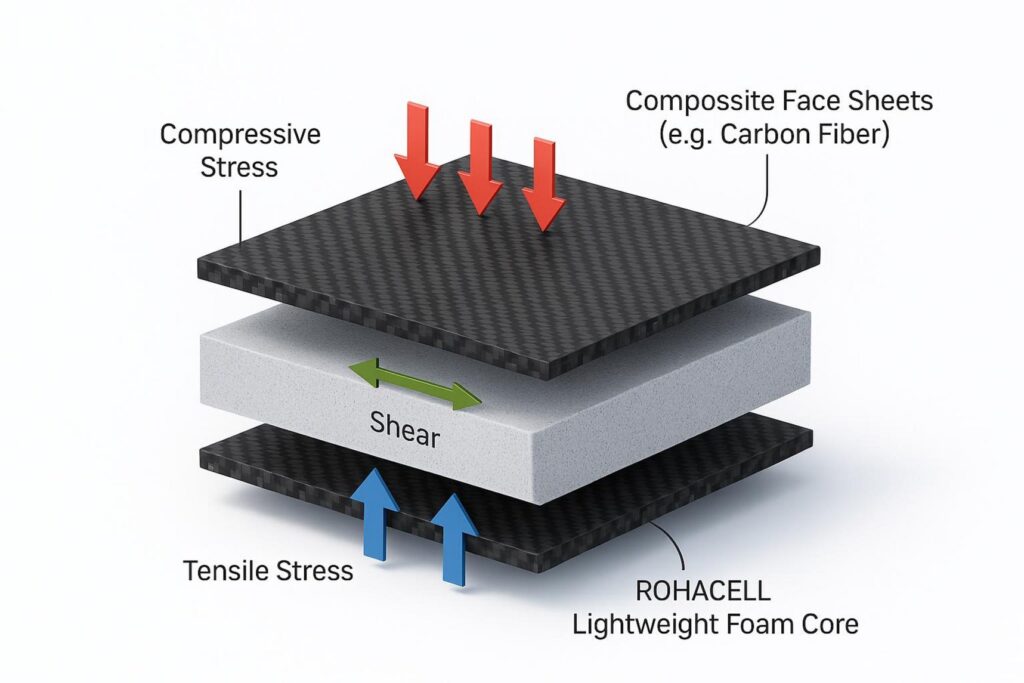
Grades such as Rohacell HF, IG-F, RIMA, WF, and XT are made to combine low density, strong shear strength, and heat stability. Rohacell HERO, for example, offers very high compression strength for its density, making it a strong option for aerostructures where low weight and high strength are both needed.
Thermal Stability and Performance at Elevated Temperatures
Heat stability is one of ROHACELL’s main strengths. Many common foams weaken with heat, but ROHACELL keeps its performance and resists creep even under long periods of changing stress. This helps composite parts keep their key mechanical properties under long-term load and higher operating temperatures. Depending on grade, ROHACELL can handle processing temperatures of about 180 to 220°C. This lets it work well with autoclave-cured prepregs and high-temperature resin systems, so demanding cure cycles can run without the core collapsing. Some PMI grades can handle autoclave cycles up to 235°C and 0.7 MPa. Rohacell XT is made for harsh autoclave use, such as 180°C at 0.45 MPa, and it can reach 240°C in a pressureless post-cure. Heat-treated options like XT-HT go further, running at 190°C under pressure, showing how stable PMI chemistry can be for future high-temperature resins like BMI (bismaleimide) systems.
Closed-Cell Structure: Moisture Resistance and Durability
ROHACELL’s 100% closed-cell structure supports long service life in tough conditions. This structure blocks water from entering, which lowers the risk of freeze damage and skin debonding seen in some other cores.
During lay-up, infusion, or RTM, the closed cells also keep resin intake low, so extra resin does not soak into the core. This helps control part weight and helps keep fiber volume fractions more consistent, leading to more repeatable part quality.
The bright white color of Rohacell HERO, along with very low water intake, is useful in aerospace. If surface damage happens, technicians can spot the area faster. The closed-cell foam also helps stop water and debris from spreading inside the part, which can make repairs faster and extend component life. Controlled tests showed Rohacell HERO limited water entry to about 5-6 mm around an impact area, while honeycomb cores showed much wider spread.
Exceptional Processability and Machinability for Fabrication
ROHACELL foam core is well known for being easy to process, giving engineers more freedom during fabrication. Its uniform internal structure leads to predictable machining and dependable bonding, which supports steady production quality.
ROHACELL can be shaped by CNC machining, sawing, waterjet cutting, and laser cutting. It cuts cleanly and creates fine plastic dust instead of fibers, which can make cleanup and tool care easier. This supports accurate 3D core shapes that fit well and make skin lay-up simpler. PMI foams can also be thermoformed, which helps in automated production.
Many complex shapes can be formed with less machining, which cuts waste and allows shapes that are hard to make by cutting alone. CNC machining still matters for tight features, while thermoforming can handle much of the main shaping, especially when engineers work with ROHACELL grades available from Chem-Craft.
Low Resin Uptake: Reducing Composite Weight
A major ROHACELL benefit, which affects both final weight and cost, is its very low resin uptake. Because of its closed-cell structure, it reduces resin flow into the core during lay-up, infusion, and resin transfer molding. Controlling resin intake helps keep laminate weight on target and supports consistent fiber volume fractions. The RIMA grade, for example, was made to reduce resin absorption to about 50 g/m² in typical infusion-something earlier PMI foams could not reach. This allows new uses where resin weight used to be a problem.
The newer ROHACRYL® acrylic foam also has low resin uptake (around 250 g/m²), which can reduce material cost per part in higher-volume production. Using less resin can mean lighter parts and lower resin spending.
Foam Grades and Density Options for Design Flexibility
ROHACELL is a product family with many grades and densities, which gives engineers a lot of design choice. This range makes it easier to pick the right material for the job. Lower density grades fit parts where the lowest weight is the top goal, such as aerospace.
Medium density options balance strength, machining, and surface durability for many structural uses. Higher density grades offer more compression strength, stronger edges, and better handling for tougher areas. There are also special grades for specific needs, such as very high-temperature processing or RF/electronic uses where low dielectric constant and low dielectric loss matter.
Chem-Craft often specifies Rohacell HF, IG-F, RIMA, WF, and XT. HF, with its very fine cell structure, keeps resin uptake low and works well for antenna and radome needs. It can also help medical imaging where even density supports image quality. Rohacryl SW, an acrylic sheet foam, adds more options for demanding marine and transport structures.
Engineering Considerations When Using ROHACELL Foam Core
ROHACELL has clear benefits, but getting the best results depends on good engineering choices. Knowing these factors helps with performance and smooth production.
Processing Temperatures and Compatibility with Resins
A key engineering point with ROHACELL foam core is matching it with the right resin system and processing temperature. Picking the right core grade matters for manufacturing fit and final part performance. ROHACELL PMI grades are made to work well with advanced methods used in aerospace, wind energy, and automotive work. Its heat stability lets it be used with autoclave-cured prepregs and high-temperature resin systems, which many other cores cannot handle as well. Standard ROHACELL grades can handle processing up to 130°C, while XT grades handle 180°C processing and can take 240°C in a pressureless post-cure.
Heat-treated XT-HT variants can run at 190°C under pressure. This wide temperature range helps engineers match a ROHACELL grade to many epoxy systems, which are often chosen for their compatibility with cores and fabrics, good adhesion, and curing behavior.
Mechanical Testing: Flexural, Impact, and Compression Strength
Mechanical testing matters when designing sandwich parts with ROHACELL foam core, since it helps predict behavior under different loads. Evonik Industries publishes material data based on standard industry tests, giving designers the numbers needed to estimate stresses over a part’s life.
Common tests include quasi-static penetration (QSPT), bending, and impact tests, which help show how the structure responds to local loads. ROHACELL may show lower compressive and tensile strength than Balsa in some cases, but it performs very well in other areas.
For example, ROHACELL cores can reach impact resistance up to 12 kJ/m². Its closed-cell structure helps absorb energy by cell wall deformation and localized crushing. In one comparison, a CFRP/Rohacell/CFRP sandwich reached about 11.9 kJ/m², around twice the impact value of a CFRP/Balsa/CFRP setup (6.9 kJ/m²), especially when loaded from the cover laminate side.
Design Guidelines for Sandwich Structures and Component Integration
Designing with ROHACELL foam core usually focuses on sandwich composite structures. Here, ROHACELL is bonded between strong outer skins, often carbon fiber, glass fiber, or aramid. The idea is simple: skins take the main tensile and compressive loads, while the core keeps them apart and handles shear. This raises bending stiffness without adding much weight.
Consistent manufacturing quality, supported by tight process control, also matters. It helps keep density, mechanical properties, and thickness tolerances steady across batches, which is needed in industries that cannot accept material variation.
Digital design tools also support better layouts, letting engineers adjust core thickness and density where needed-thicker/denser in high-load zones, thinner where loads are lower-so overall weight can drop even more than with a uniform core.
How ROHACELL Foam Core Improves Manufacturing and Sustainability
ROHACELL foam core is not only about strong material properties. It also supports advanced manufacturing methods and helps meet sustainability targets that now drive many design decisions.
Integration with Advanced Manufacturing: CNC, Resin Infusion, and Autoclave Processes
High-performance structural foam cores like ROHACELL are active parts of the design, built to work well in modern manufacturing. PMI grades support high-temperature processing used for UAVs, wind turbine blades, and automotive composite panels. They work with RTM, vacuum infusion, and autoclave curing. As more manufacturers move to out-of-autoclave processing to cut equipment costs and make larger parts, newer ROHACELL grades have been developed to suit these methods, with focus on low resin uptake and shape stability under vacuum.
PMI foams can also be thermoformed, which helps automated production by forming complex core shapes with less machining, lowering waste and allowing complex geometry. CNC machining can then be used for precise details. Manufacturing progress with ROHACELL is also being influenced by artificial intelligence. CHEM-CRAFT has filed a patent application (P.453046, August 2025) for an automated PMI plate production system using AI for real-time optimization and production forecasting. This could improve tolerances, cut waste, and make production planning more flexible, supporting Industry 4.0 goals.
Reducing Energy Usage through Lightweighting
The main value of lightweighting with ROHACELL foam core is lower energy use over a product’s full life. Lighter structures help OEMs meet efficiency and sustainability goals without giving up strength. In transport, less weight means less energy is needed to move, which improves fuel economy and increases EV range.
Sandwich structures using ROHACELL foam composites can reach up to a 20% mass reduction in vehicle structures, while also improving thermal stability by 25%. Adding Rohacell IG-F or XT to automotive composite panels can reduce weight by up to 20 kg per platform, helping extend EV range.
Over time, lower structural mass leads to ongoing fuel or energy savings in aircraft, cars, and marine vessels, cutting overall emissions.
ROHACELL Support for Sustainability and Recycling Trends
Sustainability is now a must-have in material selection, and ROHACELL foam core is adapting to that. Lightweight materials already reduce energy use during the use phase, but more attention is now on production and end-of-life. Manufacturers have improved production steps to cut waste and energy, and newer plants may use closed-loop systems that capture and reuse process materials.
End-of-life options have also progressed with recyclable foam formulations. Some high-performance grades with crosslinked chemistry can be harder to reprocess, but newer materials like ROHACRYL® were made with recyclability as a main goal. This supports new regulations like PFAS limits and the EU Green Deal, which push industries to use more sustainable chemistry.
Programs like Germany’s EPP Loop (targeting 75% recovery by 2030) show how end-of-life recovery is becoming a basic engineering requirement. With over 45% of manufacturers investing in thermoplastic foam options meant for closed-loop recovery, plus work on mono-material recyclable foams and chemical recycling systems, the industry is moving toward a workable circular economy.
What Are the Main Applications for ROHACELL Foam Core?
Because ROHACELL foam core is flexible and high-performing, it is used across many advanced sectors, each using its benefits in different ways.
Aerospace: Aircraft, Satellites, and UAV Components
Aerospace work demands very high stiffness-to-weight and strong heat stability, which is why ROHACELL is widely used. PMI foam is built into parts like composite fuselage sections, engine cowlings, and interior panels. Rohacell HERO targets aerostructures and can offer up to a 19% weight reduction and a 30% cost reduction.
It is recommended for wings, landing gear doors, radomes, vertical and horizontal stabilizers, ailerons, flaps, elevators, and rudders-especially where surface impact damage is more likely.
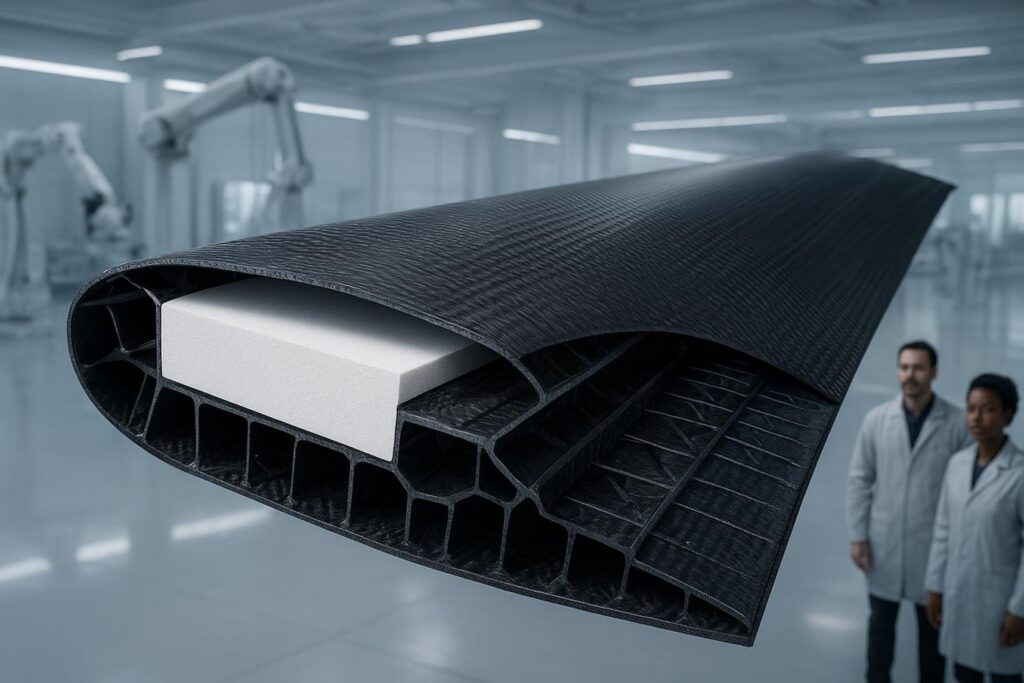
Rohacell HF is often used for radar antennas and radomes because its dielectric properties closely match air, which supports good signal flow. In defense, FST-compliant foams are used for UAV structures and hydrogen storage parts that must handle extreme thermal cycling. New areas like urban air mobility (eVTOLs) and space launch vehicles also use PMI foam to hit aggressive weight targets for better payload and range.
Automotive and Motorsport: Crash Structures and Body Panels
Automotive makes up a large share of high-performance foam use (about 35%), using structural foams to cut mass. Using Rohacell IG-F or XT in composite body panels can lower vehicle weight by up to 20 kg per platform, helping EV range. Structural foams can also reduce noise, vibration, and harshness (NVH), and acoustic foams can target specific frequency bands in EV cabins.
Battery insulation is another major use: about 65% of EV manufacturers in the U.S. (and 68% globally) use engineered foam parts for battery heat control and impact protection. In motorsport, including Formula One, the need for very low weight and strong crash structures makes ROHACELL a key material. Flame-retardant grades also support long service life in railcars and buses.
Medical Devices and Diagnostic Equipment
In medical technology, accuracy, low weight, and patient safety matter. ROHACELL foam core is used in important areas. The ALASTA principle, which focuses on reducing radiation exposure, supports the use of lightweight cores like Rohacell IG-F in X-ray and CT patient tables. These foams give stiff support while avoiding image interference, helping produce clear scans.
The fine cell structure of the HF grade can also support imaging where stable density affects image quality. ROHACELL is also used in advanced prosthetics, where low weight can improve comfort and daily use.
Energy: Wind Turbine Blades and Electronics
The energy sector, especially renewables, gains a lot from ROHACELL. Its high strength-to-weight and fatigue resistance make it a good core for large wind turbine blades. In electronics, ROHACELL supports thermal and dielectric control, and is used in RF, microwave, and antenna boards. EV battery factories, especially in Asia-Pacific, have increased use of thermal barrier foams by over 40% since 2023 to meet stricter short-circuit isolation rules.
Polyimide micro-cellular foams are also helping high-performance computing by offering very low dielectric constants for AI server clusters. In energy storage, ROHACELL can provide cryogenic insulation for liquid hydrogen tanks and strong thermal barriers for battery packs, meeting tough safety and performance needs.
Sports and Marine Structures
Sports and marine designs also benefit from ROHACELL foam core. Marine designers use sandwich construction with ROHACELL in bulkheads and decks to reduce draft and fuel use while keeping strong resistance to hydrodynamic loads. Resistance to water intake and freeze damage is a big plus in marine conditions.
In elite sports gear, advanced foams act as the inner structure for high-load parts like bicycle wheels, skis, and hockey sticks, where low weight and good fatigue behavior matter. Acrylic sheet foams like Rohacryl SW are also used for demanding marine and transport structures, showing how wide the use cases can be.
Electronics: RF, Microwave, and Antenna Boards
For RF, microwave, and antenna board applications, ROHACELL offers grades built for strict electrical needs. These uses need low dielectric constant and low dielectric loss to keep signals clean and efficient. Rohacell HF is often chosen for radar antennas and radomes because its dielectric properties closely match air, which reduces signal distortion.
Beyond antennas, crosslinked polyolefin variants can be used to build very thin profiles for electromagnetic compatibility (EMC) shielding and advanced driver-assistance systems (ADAS) sensor housings, showing ROHACELL’s fit with fast-moving electronics and telecom needs.
Frequently Asked Questions about ROHACELL Foam Core
People looking at ROHACELL foam core often ask practical questions about cost and where it fits best. Here are common questions and clear answers.
What Are the Cost and Lifecycle Benefits Compared to Other Foams?
Advanced structural foam cores like ROHACELL can cost more upfront than older fillers, but they can lower total lifecycle cost. In transportation, fuel savings from lower mass can offset higher material cost over time. In manufacturing, ROHACELL’s closed-cell structure lowers resin use during lay-up, which saves material cost. Its heat stability also helps prevent core collapse in high-temperature autoclave processing, which can reduce scrap and rework.
In aircraft production, Rohacell HERO has shown up to a 30% overall cost reduction due to better damage tolerance and easier repair. ROHACRYL® can also cut cost through low resin uptake, lowering material cost per part in higher-volume production. Taken together, these points show how long-term savings can outweigh the initial price.
Which Industries Benefit Most from ROHACELL Core?
ROHACELL core helps most in weight-sensitive and heat-sensitive uses where performance, reliability, and safety must stay high. Aerospace is a top example: sandwich construction supports high stiffness-to-weight in fuselages and radomes, and every kilogram saved improves operation. Automotive, especially EVs, uses ROHACELL to cut mass for longer range and for battery protection, with 68% of EV manufacturers worldwide using foam for this purpose.
Energy uses include wind turbine blades, cryogenic insulation for liquid hydrogen storage, and thermal barriers for battery packs. Medical devices, marine structures, elite sports equipment, and advanced electronics (RF, microwave, antenna boards) also use ROHACELL for its mix of benefits in demanding conditions. In construction, cellular insulation can reduce HVAC energy use by up to 30%, helping net-zero targets.
What Are the Long-Term Durability and Maintenance Considerations?
ROHACELL foam core is built for long service life and easier maintenance. Its low weight and high stability support good fatigue behavior and help avoid issues like water intake, freeze damage, or skin debonding that can affect other cores. ROHACELL also holds its mechanical properties under long-term load and higher temperatures, supporting structural strength over time.
For aerospace maintenance, the bright white color of grades like Rohacell HERO stands out against carbon fiber laminates, helping technicians spot impact damage during inspections. The closed-cell structure also helps block water and debris from moving deeper into the core, which makes damaged areas easier to clean and repair. This can reduce repair time and extend the life of aircraft parts.
Research continues to study long-term performance of these sandwich composites under aerospace environmental conditions to confirm and improve long-term reliability.
What Sets ROHACELL Foam Core Apart in Lightweight Structural Design?
ROHACELL foam core is a reference point for lightweight structural design because of its strong PMI chemistry and the steady progress in how it is made and used. It has become a key material in advanced composite manufacturing, helping engineers reach strong stiffness-to-weight and keep manufacturing compatibility across many industries.
What makes ROHACELL different is the ongoing push in material development and manufacturing methods. Engineers keep asking for higher temperature performance, and PMI chemistry already offers room for growth, which supports work in harsher environments. Manufacturing progress is also being shaped by artificial intelligence. CHEM-CRAFT has filed a patent application (P.453046, August 2025) for an automated PMI plate production system that uses AI for real-time optimization and production forecasting. This points to tighter tolerances, less waste, and more flexible production planning, which helps in applications where steady quality and dependable supply matter.
As Industry 4.0 adoption grows, design-for-recycling methods-shown by newer materials like ROHACRYL®-will keep shaping product development, helping ROHACELL stay aligned with sustainable material goals. This mix of proven performance, steady innovation, and modern production methods makes ROHACELL foam core a practical choice for engineers working on difficult lightweight structure problems, from autonomous delivery systems and next-generation space launch vehicles to advanced prosthetics.