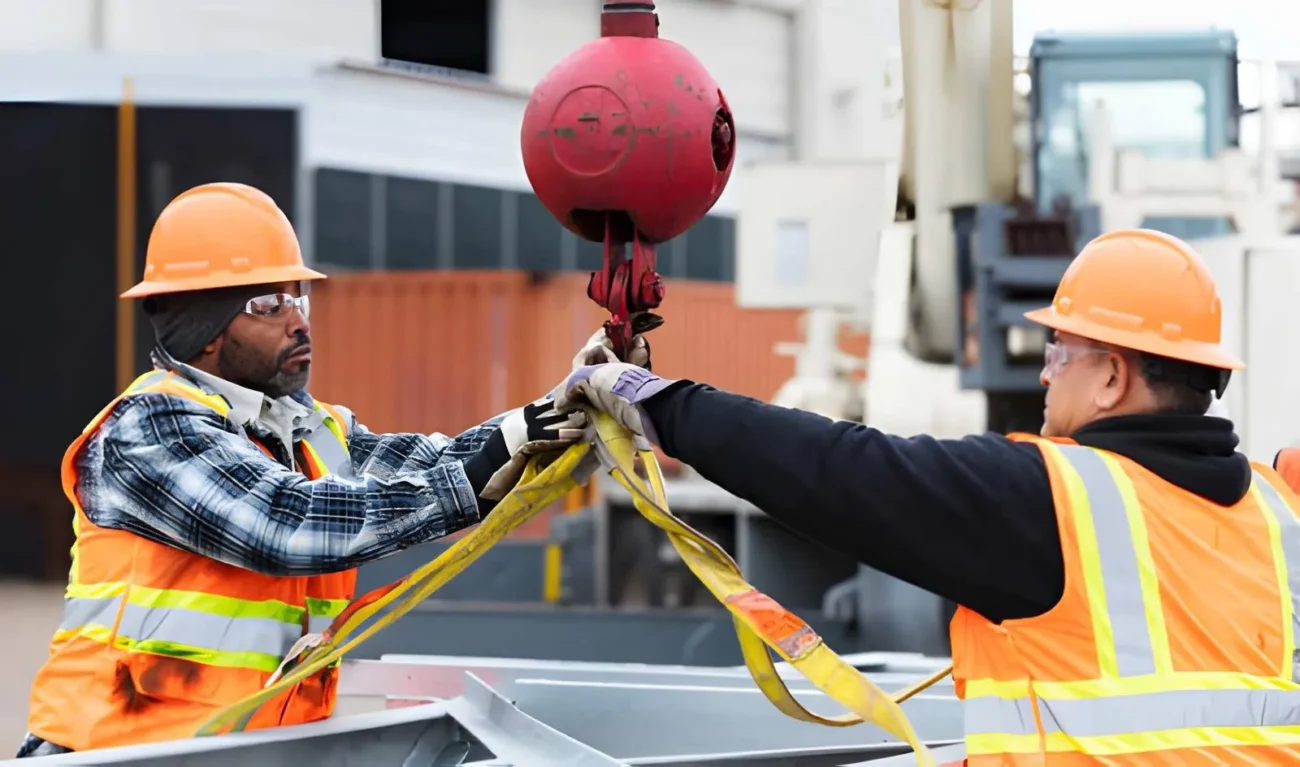
Moving a large machine across an open yard is one thing; moving the same machine through an operating factory, around structural columns, beneath pipework and through an opening only slightly wider than the load is something entirely different. In these situations, industrial rigging and machinery moving becomes an exercise in precision, planning and controlled movement rather than simply lifting something heavy. The challenge is often less about whether the machinery can be raised and more about whether it can be manoeuvred safely through a route where every centimetre matters. Successful tight-space moves therefore depend on understanding the building, the equipment and the sequence of movement before the first piece of rigging is attached.
Older factories can make this particularly difficult. Many industrial buildings have evolved over decades, with production lines added, walls altered, services rerouted and new machinery installed wherever space was available. Equipment that originally entered through a large access door may now be surrounded by conveyors, storage systems or structural modifications that did not exist at the time. When the machine eventually needs to be replaced or relocated, the route out can be considerably more complicated than the route it originally took in.
That is why experienced rigging teams often begin with the path rather than the machine itself.
The Route Is the Real Starting Point
A machine may be perfectly capable of being lifted, but that does not mean it can be moved directly to the exit. The route has to be examined in detail, including door widths, ceiling heights, floor conditions, corners, overhead services and any equipment that cannot be disturbed.
Turning radius can become one of the biggest constraints. A long machine might fit through a doorway but be unable to rotate sufficiently to line up with it. A load may clear the walls at floor level while an upper section strikes ducting or cable trays. Even a few centimetres of unexpected projection can turn an apparently straightforward move into a much more complex operation.
This is why detailed measurements matter. The overall height, width and length of the machine need to be known, but so do any irregular features such as control cabinets, motors, guards, pipe connections or protruding components. Where possible, removable sections may be taken off to reduce the envelope of the load, but dismantling is not always practical or desirable.
The building must be measured just as carefully. Door openings may not be perfectly square, and industrial floors can include slopes, drains, thresholds or damaged sections that affect how machinery moves. A route that appears clear on a floor plan may look very different when inspected in person.
In particularly constrained environments, moving the machine may involve creating a detailed sequence of small movements rather than one continuous journey. The load could be shifted sideways, rotated gradually, lowered, repositioned and then moved again once the correct angle has been achieved.
When Cranes Cannot Reach the Load
Open construction sites often allow mobile cranes to approach relatively close to heavy equipment. Inside an existing factory, there may be no such option.
Ceiling height can prevent conventional crane use, while structural beams, mezzanines and production equipment may leave little room for lifting. In those circumstances, rigging teams may use alternative systems such as hydraulic gantries, machinery skates, jacks, rollers or other specialised equipment designed to move heavy loads within restricted spaces.
The choice depends on the machine and the building.
Machinery skates can allow a heavy load to move across a suitably prepared floor while keeping its overall height relatively low. Hydraulic systems can raise equipment in a controlled manner where overhead clearance is limited. Gantries can sometimes provide lifting capability in locations that a mobile crane could never physically access.
The important point is that rigging equipment is selected around the problem rather than simply around the machine’s weight.
A compact machine weighing several tonnes may still be relatively easy to handle if it has clear access and strong lifting points. A lighter machine may be far more difficult if it is trapped between structures, has an awkward centre of gravity or needs to pass through a narrow corridor.
The move therefore has to be engineered around the specific geometry of the site.
The Floor Becomes Part of the Rigging Plan
When machinery is moved using skates or rollers, attention naturally shifts towards the floor.
Industrial floors are not always as uniform as they first appear. Cracks, joints, slopes and changes in level can interfere with the movement of heavily loaded skates. A minor threshold that would barely be noticed by a forklift can become a significant obstacle when several tonnes are concentrated onto relatively small contact areas.
The floor also has to support the temporary loads created during the move. A machine may normally distribute its weight across a broad foundation, but once lifted onto skates or jacks, that same weight may be concentrated through fewer points.
This changes the loading conditions considerably.
Rigging teams may therefore use steel plates, mats or other load-spreading methods to create a controlled path and protect the floor. These measures can also help machinery move more smoothly across uneven sections or transitions between different surfaces.
Where basement areas, service tunnels or suspended floors exist beneath the route, the issue becomes even more important. A floor that easily supports ordinary factory traffic may require additional assessment before unusually high point loads are introduced.
Tight-space machinery moving is therefore not only about fitting through gaps. It is also about ensuring that every surface beneath the load can safely support each stage of the operation.
Sometimes the Building Has to Change
There are situations where the machine simply cannot leave through the existing route.
A doorway may be too small. A wall may have been constructed after the equipment was installed. The original roof opening used during installation may have been permanently closed. In such cases, modifying the building can be more practical than dismantling the machinery.
Temporary structural alterations might involve removing a door frame, creating a larger opening or temporarily taking down sections of wall. In some projects, roof panels may be removed so equipment can be lifted vertically rather than manoeuvred through the building.
These changes require coordination with structural and building specialists, because an opening cannot simply be created wherever it is convenient. Services may need to be isolated or rerouted, and the building must remain stable throughout the work.
Timing becomes particularly important when a facility is still operating.
A temporary wall opening may expose the production area to weather or security concerns, so the period during which the building remains open may need to be kept as short as possible. The machinery move, lifting operation and reinstatement work therefore need to be sequenced closely.
In some cases, the easiest part of the project is physically moving the machine. The harder task is creating and restoring the route around it.
Protecting the Equipment Is Just as Important as Protecting the Building
Large machinery is not necessarily robust simply because it is heavy.
Precision equipment can contain delicate components, aligned assemblies and sensitive control systems that may be damaged by excessive movement or poor lifting technique. A machine that weighs many tonnes can still be vulnerable to twisting if lifted from inappropriate points.
Tight-space moves increase this risk because loads may need to be repositioned several times. Instead of a straightforward lift and set, the machine may be jacked, rotated and transferred between different handling systems.
Each transition needs to remain controlled.
The manufacturer’s lifting information, where available, can be valuable. Known lifting points, centre-of-gravity information and restrictions on how the machine may be supported can influence the rigging plan.
If documentation is incomplete, additional assessment may be necessary before movement begins.
Protective measures may also be used around both the equipment and the building. Corners, door frames and nearby machinery can be protected from incidental contact, while sensitive components on the moving machine may be removed or shielded.
The goal is not simply to complete the route. It is to complete it without creating damage that only becomes apparent during recommissioning.
Communication Matters More When Space Disappears
The tighter the working environment becomes, the more important coordination between team members becomes.
A crane operator working in an open area may have a relatively clear view of the load. In a confined industrial move, the person operating the lifting or moving equipment may not be able to see every clearance point.
Spotters therefore become essential.
Different team members may monitor the front, rear, overhead and side clearances while one person coordinates the movement. Clear signalling prevents several people from giving conflicting instructions at the same time.
Movement may deliberately be slow.
A load moving only a few centimetres can significantly change the clearance around a corner or doorway. Stopping frequently to check position is often more efficient than allowing a problem to develop and then having to reverse the entire move.
This controlled pace can look unnecessarily cautious to someone watching from a distance, but precision is what allows large equipment to pass through spaces that offer very little margin for error.
A Few Millimetres Can Change the Entire Method
Tight-space machinery moves are a good example of why industrial rigging is fundamentally a planning discipline.
The weight of the equipment establishes one set of requirements, but the building can impose an entirely different set. A narrow doorway changes how the load must be orientated. Limited headroom changes which lifting system can be used. An uneven floor changes how machinery skates can travel. A structural column changes the turning sequence.
Each constraint affects the others.
That is why the best solution is not always the most obvious one. Moving a machine directly towards the nearest exit may look logical until the turning radius is considered. A longer route through another part of the facility may actually require fewer complex movements and reduce the overall risk.
Successful teams therefore treat the site almost like a three-dimensional puzzle. They consider where the load begins, where it needs to end and every controlled movement required between those two points.
Once the plan is established, the move itself can sometimes appear surprisingly uneventful. Machinery is raised, positioned and gradually guided through spaces that initially looked far too small.
That apparent simplicity is usually the result of the work done beforehand.
In constrained industrial environments, brute force rarely solves the problem. Precision does. The combination of detailed measurement, appropriate rigging equipment, careful floor preparation and disciplined communication allows heavy machinery to move through buildings that were never designed with relocation in mind.
When space is limited, successful machinery moving is ultimately less about how much can be lifted and more about how accurately every movement can be controlled.